For the last 20 years, software worked like this:
You had an idea. You built features. Users requested improvements. You added more features. You maintained a roadmap. Ship. Wait. Iterate.
But something fundamental is changing. We are entering a phase where users don't just use features—they generate them. And the companies that understand this shift early will win disproportionately.
The Old Model: Static Software
Traditional SaaS works like a vending machine. You press a button → you get what the engineer pre-built. If what you need isn't there? You submit a feature request.
This model assumes:
- The product team knows all meaningful use cases.
- Innovation flows from the company → user.
- Software is static until the next deployment.
That model made sense in 2010. It makes less sense in 2026. Users today expect software to adapt to their workflow, not the other way around.
We're moving into an era where features are generated at runtime.
Instead of: "Add dark mode in the next sprint."
It becomes: "Generate a custom dashboard filtered by X, Y, Z."
Instead of: "Wait for integration support."
It becomes: "Create an automation that connects these systems."
Artificial intelligence systems from companies like OpenAI and Google are accelerating this shift by turning natural language into an executable interface. Users increasingly interact with software through instructions instead of menus. This idea is not theoretical; we are already seeing early versions of it across modern software platforms.
Real-World Examples of Users Building Inside Products
Several companies have already built systems where users effectively generate new functionality.
Notion
Notion started as a note-taking tool but evolved into a flexible workspace where users build entire systems: CRMs, content pipelines, knowledge bases, and project dashboards. Many of these use cases were never explicitly designed by the company.
Zapier
Zapier allows users to connect thousands of applications and build automated workflows. Each new "Zap" effectively becomes a new micro-feature inside the Zapier ecosystem.
Airtable
Airtable lets users build custom applications on top of structured data. Companies use it to build everything from CRMs to talent platforms and internal tools without writing code.
Retool
Retool allows organizations to build internal applications rapidly by composing data sources, APIs, and UI components. In many companies, non-traditional engineers now assemble full operational tools inside the platform.
These systems share a common principle: They provide building blocks rather than finished products.
The Post-Static Software Era
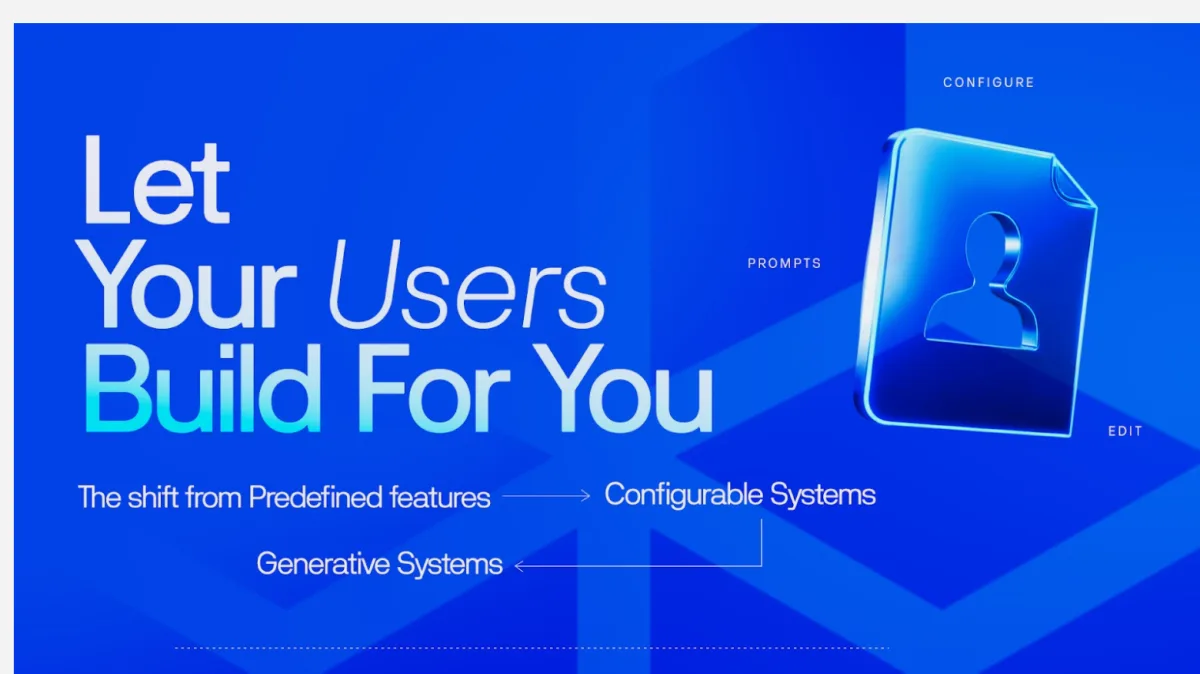
We are moving from: Predefined features → Configurable systems → Generative systems
This is bigger than AI chat. This is architectural. It means:
- Users can define workflows.
- Users can generate reports.
- Users can create automations.
- Users can compose new functionality.
- Users can spin up micro-tools inside your product (with a button, a prompt, or a configuration layer).
The product becomes a runtime engine, not a fixed toolkit.
What This Means for Founders
If you're building software today and your roadmap looks like this:
- Q1: Add export feature
- Q2: Add integration
- Q3: Add dashboard customization
You may be building 2015 software. The question is no longer: "What features should we build next?" The more important question is: "How do we build a system that lets users build what they need?"
This requires a shift in thinking:
- Instead of: Product → Features
- Think: Product → Capability Engine
Instead of shipping UI components, ship composable primitives.
The Strategic Advantage
Letting users build inside your product creates powerful advantages:
- Reduced engineering backlog: Users solve their own edge cases.
- Faster adaptation: Niche use cases are handled instantly.
- Stronger stickiness: A system a user built themselves is harder to leave.
- Community innovation: Users share templates and workflows.
- Exponential expansion: Your product's utility grows faster than your team can code.
Your product becomes a platform. And platforms scale differently. As Jensen Huang once observed about modern computing systems: "The future of software is increasingly programmable and accelerated." Systems that allow users to create on top of them tend to grow far beyond their original design.
A Practical Scenario
Consider a customer support platform. Traditional software might ship features like:
- Ticket tagging
- Auto-response templates
- Workflow automation
But a generative system might allow a user to type:
"Create a workflow that tags refund requests, checks order history, and notifies finance."
Instead of waiting for a roadmap update, the software creates the feature dynamically. This drastically shortens the cycle between problem and solution.
The Architecture Behind It
Building systems where users can generate functionality requires deliberate design. Key elements include:
- Modular backend architecture
- Clear and extensible APIs
- Permission-safe execution layers
- Structured configuration systems
- Optional AI orchestration for natural language interaction
This is not simply "adding AI." It is designing software so that capabilities are composable. The companies that win this era will not be the ones with the most features; they will be the ones with the most extensible core architecture.
The Risk
Of course, this power comes with trade-offs. Too much flexibility can create chaos. Poor abstractions can create fragile systems. Giving users unlimited freedom without guardrails can break the product. The real design challenge becomes: Constraint + Flexibility. Give users power, but design boundaries carefully.
Software has evolved through several stages:
Software as a Product → Software as Infrastructure → Software as a Programmable Environment
The next phase of technology is not about better dashboards; it is about giving users leverage. When users can build inside your system, growth stops being linear. It becomes combinatorial.
Final Thought
Are you building a static tool, or are you building a surface for creation? The future belongs to products that turn users into builders. And the companies that understand this shift early won't just ship faster—they'll evolve faster.
Want to build a product that scales itself? Let's talk.