Introduction
Software has been centred around screens for decades. We moved from desktop computing to mobile applications, from websites to native apps, and from command-line systems to graphical user interfaces. Every advancement enhanced accessibility and decreased friction.
We are now getting close to yet another turning point: Conversation-driven execution is replacing interface-driven software.
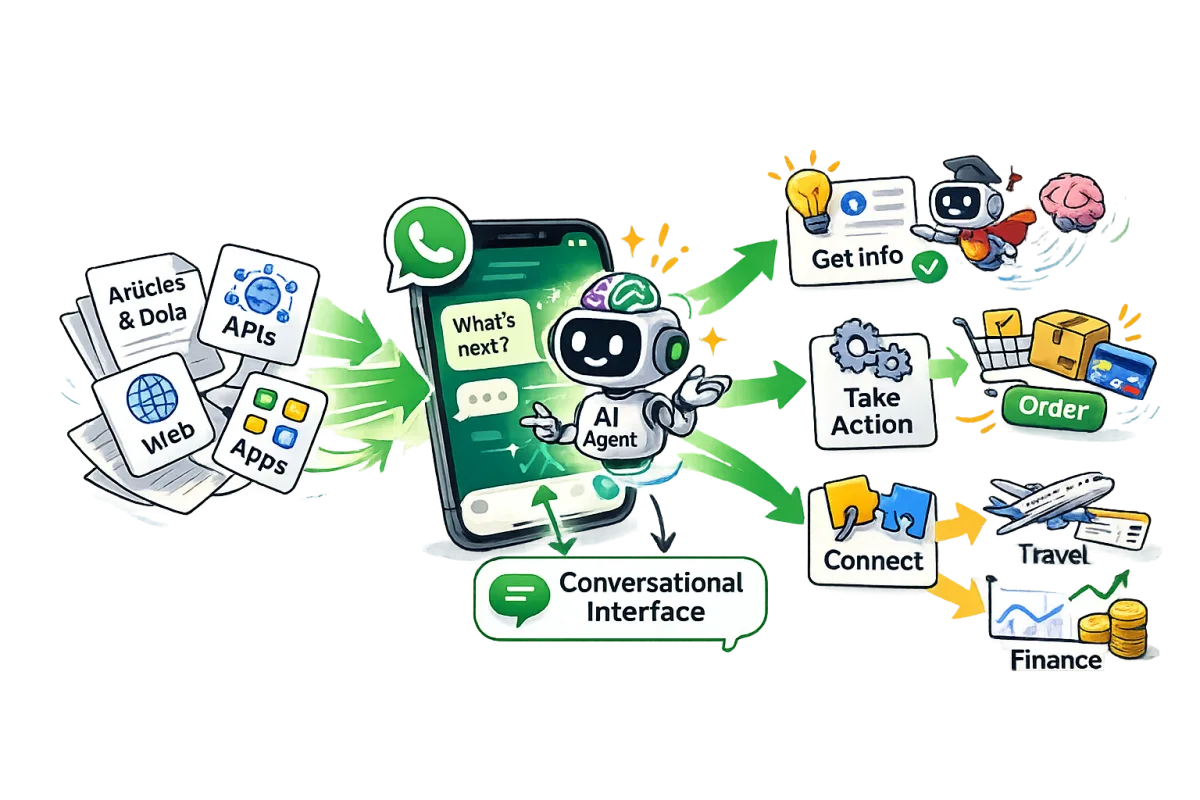
A new operating system or app store might not be at the core of this shift. It may be WhatsApp, powered by AI agents.
Distribution Has Already Been Resolved
WhatsApp is one of the most extensively used digital platforms in history, with over two billion monthly active users worldwide, according to Meta.
WhatsApp is more than just a chat service in marketplaces in sections of Europe, South Asia, Africa, and Latin America. It serves as a digital infrastructure. It is used by businesses to run shopfronts. It is used by customer service. It is where payments are started.
In contrast, there is increasing conflict in the conventional mobile app ecosystem:
- After just one use, a sizable portion of consumers give up on apps.
- Few, if any, new apps are downloaded by the typical smartphone user each month.
- New applications are becoming more difficult to distribute.
It has already been surmounted by messaging platforms.
From Interface Navigation to Intent Expression
Traditional applications use structured navigation:
- Menus
- Dashboards
- Forms
- Workflows with multiple steps
Before obtaining value from software, users must understand how it operates. This model is reversed by AI agents. Users express intent rather than navigating features:
"Next Friday, book a flight to Berlin."
"This document should be summarised."
"At six in the morning, arrange a ride to the airport."
Interpreting, reasoning, executing, and responding are all done by the system. This signifies a fundamental change from manipulating interfaces to orchestrating outcomes.
Proof That the Transition Is Taking Place
Klarna's Use of AI
Klarna revealed in 2024 that its AI assistant was managing a significant percentage of customer service conversations, completing tasks comparable to those of hundreds of support agents while preserving customer satisfaction levels.
The lesson is simple: Resolution is more important to users than interface.
WeChat as an Example
Tencent converted WeChat into a multipurpose platform that combines public services, healthcare reservations, payments, and transportation into a single messaging interface. WeChat serves as an example of how messaging can develop into a daily operational layer.
Similar developments on WhatsApp, bolstered by sophisticated AI agents, might take place on a worldwide scale.
Not sure where to start with AI?
Book a free 30-minute AI Blueprint Session. We'll diagnose your workflow and map out exactly how custom AI can save costs or drive revenue for your product.
Book Your Free BlueprintWhen Applications Become Infrastructure
An essential skill is demonstrated by open-source agent frameworks like OpenClaw: autonomous systems capable of navigating digital surroundings, interacting with interfaces, and carrying out tasks on behalf of users.
Think about transportation. Instead of opening the Uber app, entering pickup details, selecting ride options, and confirming payment, a user could simply message:
"Tomorrow at six in the morning, I need a ride to the airport."
An intelligent agent could:
- Check your calendar commitments.
- Verify the flight schedule.
- Select ride preferences.
- Execute the booking.
- Deliver confirmation.
Uber does not vanish under this model. It becomes infrastructure accessed through conversational orchestration. Applications compete on service performance and API dependability rather than interface design.
The Economics of Interface Elimination
Friction is introduced with each extra screen. The chance of abandoning rises with each further step.
Multi-step processes are condensed into a single transaction by conversational agents. Rather than: Open → Navigate → Search → Filter → Confirm → Pay, we move towards:
"Find the most affordable flight arriving before 5 p.m."
Navigation is replaced by intent. This increases digital accessibility for a wider range of demographics and lessens cognitive burden.
Strategic Implications for Builders
Most software products today are still designed around dashboards.
Dashboards assume:
- Time commitment
- Technical expertise
- Frequent interaction
Conversational AI makes the following assumptions:
- Natural language
- Focus on outcomes
- Very little onboarding
It's possible that the upcoming generation of high-leverage software will be completely different from conventional applications. It may appear as a contact saved in a messaging app.
Conclusion: The Third Wave
Computing history can be viewed in three phases:
- Command-line interfaces
- Graphical user interfaces
- Conversational agent interfaces
WhatsApp combined with AI agents may represent the global adoption layer of this third phase. Not because artificial intelligence is new. But because distribution and intelligence are finally converging at scale.
When that convergence occurs, interfaces do not simply improve. They become invisible.
Interested in receiving easy-to-scan, deeply curated Custom AI and software development insights? Join our email newsletter.